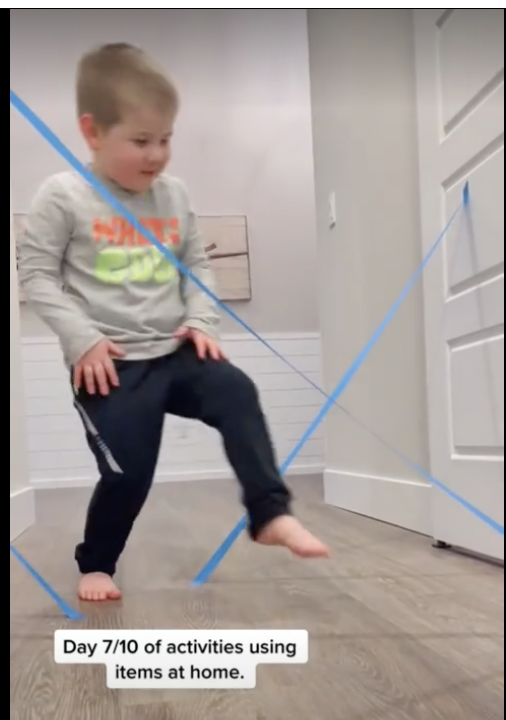
This tape laser maze for kids started as a casual Pinterest video. It now has 19,900 saves. Nineteen. Thousand. People. Apparently I’m not the only one who needs a five-minute indoor activity that actually works. So here’s the full tutorial — with the actual video from my house, step-by-step instructions, and everything you need to set it up today.
It’s a painter’s tape laser maze. You’ve probably seen it floating around — tape strung across a hallway at different angles, kids crawling and contorting themselves through it like little spies on a mission. It takes less than ten minutes to set up, costs almost nothing if you have tape already, and buys you a solid 30–60 minutes of entertained, moving, genuinely engaged kids.
Here’s everything you need to know to do it at home.
I filmed the whole thing. Watch it below — it’s only 13 seconds but you’ll immediately see why kids go absolutely feral for this:
What Is a Tape Laser Maze for Kids?
A tape laser maze for kids is exactly what it sounds like: you use painter’s tape or colored masking tape to create a web of “laser beams” across a doorway or hallway. Kids have to move through the maze without touching the tape — crawling under, stepping over, twisting sideways, whatever it takes.
It’s inspired by every spy movie scene you’ve ever watched. And kids absolutely lose it for this. There’s something deeply satisfying about the challenge of navigating a physical obstacle course, especially when they made it extra sneaky and the tape is basically at nose height.
Why This Activity Works So Well (Especially for High-Energy Kids)
I’ll be real with you — I didn’t set this up because I’m a fun craft mom. I set it up because it was winter break, we were two days in, and my kid had already watched more TV than I care to admit. I needed something that would get his body moving and his brain engaged without requiring me to actually participate for the entire duration.
This checked every box. Here’s why it works so well:
It’s proprioceptive and vestibular input — all that crouching, twisting, and maneuvering gives kids’ bodies the kind of physical feedback that genuinely regulates their nervous system. If you have a kid with ADHD or sensory needs, this kind of full-body movement is gold.
It’s self-directed — once it’s up, they run the show. They try different paths. They make new rules. They start timing themselves. You don’t have to be on the floor with them (although honestly it’s pretty fun to try yourself).
It scales with difficulty — a 3-year-old needs wide, high tape. An 8-year-old wants it tight and chaotic. You can make one version that genuinely challenges both at the same time, which is a miracle when you have multiple kids.
Cleanup is instant — just pull the tape off and you’re done. No glitter. No paint. No 47 tiny pieces of something scattered across the kitchen. Just tape.
What You Need
The only real supply is tape. That’s it. Everything else you already have at home.
 ScotchBlue PROSharp Painter’s Tape — 3 Pack
$17.94 on Amazon →
ScotchBlue PROSharp Painter’s Tape — 3 Pack
$17.94 on Amazon →
The classic. Sticks well, removes cleanly, and doesn’t take paint off your walls. 1 inch wide is perfect for hallway mazes.
 COSIMIXO 6-Pack Rainbow Colored Tape
$16.95 on Amazon →
COSIMIXO 6-Pack Rainbow Colored Tape
$16.95 on Amazon →
If you want to level it up visually — assign each color a rule. “Don’t touch the red ones.” “The yellow is worth double points.” Kids go nuts for this.
 Hutou 8-Roll Rainbow Tape Set
$6.71 on Amazon →
Hutou 8-Roll Rainbow Tape Set
$6.71 on Amazon →
The budget pick. 8 colors, super affordable, great if you want multiple colors without spending much. Rolls are thinner so great for tighter mazes.
You’ll also want: a hallway or doorway (even a small one works), about 5–10 minutes, and optionally a timer if your kids are competitive.
How to Set Up a Tape Laser Maze for Kids (Step by Step)
This is genuinely fast. Here’s what to do:
Step 1: Pick your space. A hallway is ideal because you have two walls to anchor the tape between. A doorway works too. You can even do a large room if you use furniture as anchor points — think chair legs, table legs, the couch.
Step 2: Start with one piece of tape. Pull a length of tape across the hallway at a diagonal angle and press both ends firmly onto opposite walls. This is your first “laser.”
Step 3: Layer it up. Add 6–12 more pieces at different heights and angles — some high, some low, some crossing. The more they overlap and cross each other, the more challenging and spy-like the maze becomes. Try to make some gaps wide (easy) and some tiny (hard).
Step 4: Do a test run. Walk through yourself to make sure it’s actually passable. The goal is challenging, not impossible — especially for little ones. If you can’t get through, loosen it up a bit.
Step 5: Set the rules. Tell your kids the goal: get from one end to the other without touching the tape. If they touch it, they go back to start. You can also make it a timed challenge — “Can you beat 30 seconds?”
Step 6: Let them go. Seriously, just step back and watch. They will play with this for a long, long time.
Ways to Mix Up Your Tape Laser Maze for Kids
Once they’ve mastered the original, here are some variations that keep the energy going:
Color-coded rules: If you’re using colored tape, assign each color a rule. Red tape = crawl under. Blue tape = step over. Yellow tape = go around. It adds a memory and strategy element that older kids especially love.
Add a mission: Put a stuffed animal or “treasure” at the far end of the maze. They have to retrieve it without touching the lasers. Cue the Mission Impossible theme in your head.
Reverse it: After they’ve gone forward a few times, make them do it backwards. Much harder, very funny to watch.
Team mode: Two kids have to pass a balloon or small toy through the maze to each other without letting it touch the tape. Bonus: they have to communicate and work together, which is secretly great for social skills.
Night mode: Turn the lights off and give them a flashlight. Yes, this is chaotic. Yes, it’s also amazing.
Let them build it: Older kids (5+) can set up the maze themselves. Hand them the tape and let them go. They’ll create something way more elaborate than you ever would, and they’ll be occupied twice as long.
Tips by Age
Ages 2–4: Keep the tape high and spread out so there’s room to step through easily. At this age it’s more about the novelty of the setup than actual challenge. They’ll mostly just duck under one piece and feel like geniuses.
Ages 5–7: Add more pieces and make some low. They’re ready for actual challenge and will try to beat their time. Introduce the “mission” element here — it gets them way more invested.
Ages 8+: Go wild — this age group especially loves the challenge of timed activities. Tight angles, crossing pieces, low pieces they have to army crawl under. Add a timer, a point system, or consequences for touching (start over, 5 jumping jacks, whatever works for your kid). They can also build their own maze for younger siblings, which they genuinely love doing.
Multiple kids, different ages: Set up sections of different difficulty. One end of the hallway is the “easy zone,” the other end is expert level. Everyone starts in the same place and picks their path.
Frequently Asked Questions
What kind of tape works best for a tape laser maze?
Blue painter’s tape is the best option because it sticks well to walls, floors, and door frames without leaving residue or damaging paint. Colored masking tape also works great and makes the maze more visually fun — especially if you want to assign rules to different colors.
How long does it take to set up?
About 5 to 10 minutes for a solid maze. The more elaborate you go, the longer — but honestly the basic version takes less time than convincing your kid to get off the couch.
What age is this activity for?
Ages 2 and up. Toddlers love the low-effort version, school-age kids thrive with the challenge, and tweens can build their own. Adjust the difficulty and you’ve got an activity that works for basically any kid.
Will painter’s tape damage my walls?
Quality painter’s tape is designed to remove cleanly without damaging paint. Just don’t leave it up for days at a time, and press it on firmly when you put it up so it doesn’t droop mid-maze.
How do I make it harder for older kids?
More tape at tighter angles, a timer, a scoring system, carrying something through without dropping it, doing it backwards — all work well. Older kids also love being the ones to set up the maze for their siblings.
Looking for more low-effort indoor activity ideas? Check out my tapioca sensory bin post for another easy setup that buys you serious quiet time. And if you’re parenting a high-energy kid who needs more tools in your toolkit, my post on PDA parenting scripts might also be useful.